Table of Contents
- Key Takeaways
- Quick Verdict
- Product Overview & Specifications
- Real-World Performance & Feature Analysis
- Design & Build Quality: Feather-Light, Not Bulletproof
- Performance in Real Use: Static Warmth vs. Active Use
- Ease of Use & Packability
- Durability & Reliability Over Time
- Pros & Cons
- Pros
- Cons
- Comparison & Alternatives
- Cheaper Alternative: Decathlon Forclaz MT100 Down Jacket
- Premium Alternative: Arc’teryx Cerium LT Hoody
- Buying Guide / Who Should Buy
- Best For Beginners
- Best For Professionals & Advanced Users
- Not Recommended For
- FAQ
- Is the Ghost Whisperer waterproof?
- How does the fit compare to other brands?
- Is the Ghost Whisperer worth £300?
- Can it be used as a standalone jacket in winter?
- How do I care for and wash it?
You’re searching for a down jacket that doesn’t feel like you’re wearing a sleeping bag. You want warmth without the Michelin Man bulk, a piece you can stuff in your pack and forget about until that chilly mountain pass or crisp evening at camp. The Mountain Hardwear Ghost Whisperer has been the benchmark for this specific need for over a decade. But in a market now flooded with competitors, does it still justify its price and reputation?
Having used this jacket across three seasons in the Scottish Highlands, the Alps, and as a daily urban layer, I’ve put its legendary status to the test. This isn’t a spec-sheet rundown; it’s a hands-on assessment of where the Ghost Whisperer excels, where it compromises, and who should seriously consider an alternative.
Key Takeaways
- Unmatched Packability: The Ghost Whisperer’s party trick is how it compresses to the size of a large water bottle, making it a no-brainer for ultralight backpacking and travel.
- Warmth-to-Weight Champion: The 800-fill RDS-certified down provides impressive warmth for its 200-gram weight, but it’s a specialist in static warmth, not high-output activity.
- Durability is a Trade-Off: The ultra-light 7D ripstop fabric is essential for its weight savings but is susceptible to snags and abrasion—this isn’t a bushwhacking jacket.
- Fit is Athletic: The cut is trim and modern, ideal for layering over a base layer but potentially restrictive if you prefer a relaxed fit or plan to layer thick mid-layers underneath.
- Premium Price for a Specific User: At over £290, it’s an investment best suited for weight-conscious adventurers who prioritise packability above all else.
Quick Verdict
Best for: Ultralight backpackers, fast-and-light alpinists, and travellers who need maximum warmth in a minimal package.
Not ideal for: Everyday urban wear where durability is key, winter mountaineering as a primary insulating layer, or those who run cold and need heavier insulation.
Core Strengths: Industry-leading weight (approx. 200g), incredible compressibility, excellent warmth for its minimal bulk, ethical down sourcing (RDS-certified).
Core Weaknesses: Premium price point, delicate face fabric requires careful use, minimal features (few pockets), fit may be too slim for some.
Product Overview & Specifications
The Mountain Hardwear Ghost Whisperer is the definition of a focused tool. It’s not trying to be everything to everyone. Its entire design philosophy revolves around one principle: providing the most warmth possible for the least amount of weight and pack space. This is achieved through high-quality 800-fill-power down and an exceptionally thin yet effective ripstop nylon shell.
| Specification | Details |
|---|---|
| Insulation | 800-fill-power RDS-certified down |
| Weight (Men’s Medium) | Approx. 200g (7 oz) |
| Shell Fabric | 7D x 10D ripstop nylon |
| Fit | Trim / Athletic |
| Pockets | 2 Zippered hand pockets, 1 internal chest pocket |
| Compressibility | Packs into its own chest pocket |
| Price (RRP) | £298.09 |
Real-World Performance & Feature Analysis
Design & Build Quality: Feather-Light, Not Bulletproof
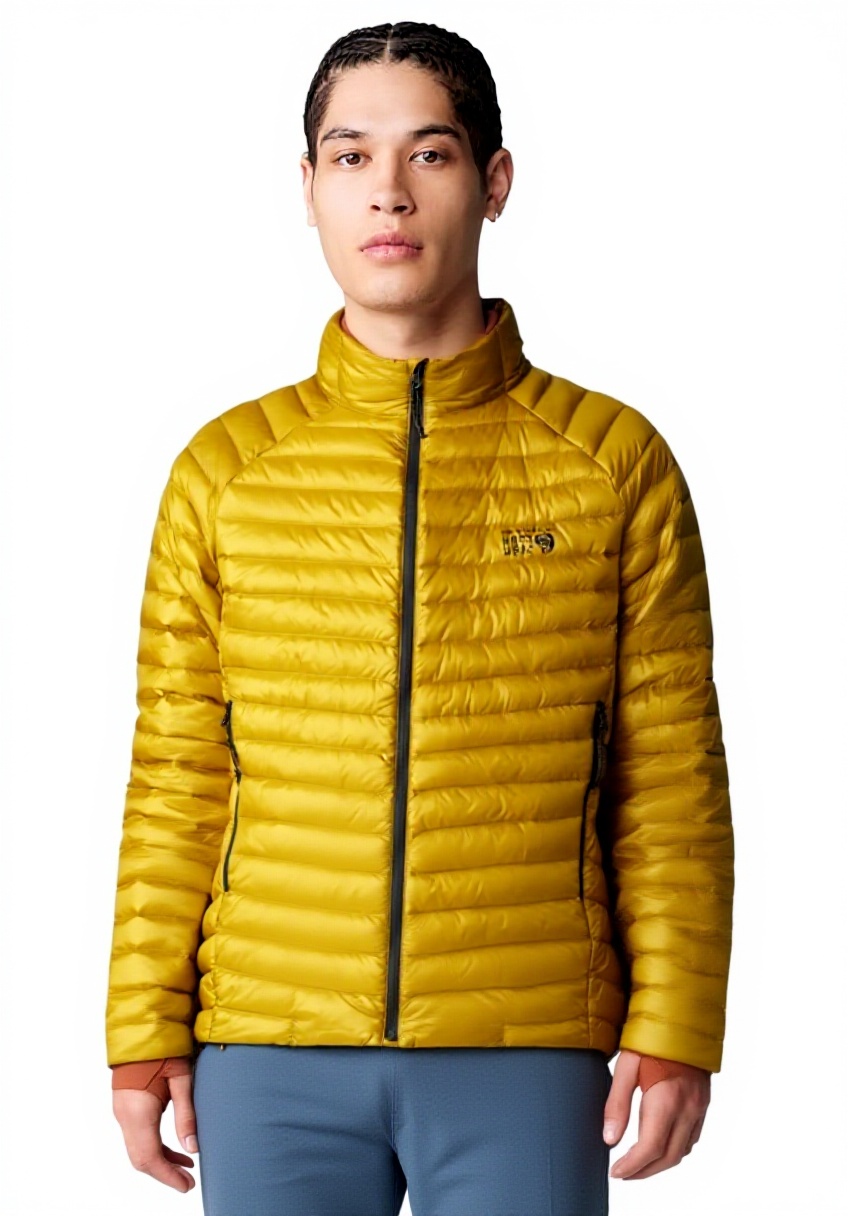
The first thing you notice is the texture—or lack thereof. The 7D fabric is tissue-paper thin, which is precisely the point. This isn’t a flaw; it’s a deliberate engineering choice to minimise weight. The stitching is impeccable, with narrow seam allowances and minimal thread to reduce ounces. The zipper is a light-grade YKK, which operates smoothly but requires a careful hand to avoid snagging the delicate storm flap.
Why it matters: This level of construction is what allows the jacket to hit its remarkably low weight. However, you trade brute-force durability for that performance. I’ve been careful with mine, but after a season of use, there’s a small snag from brushing against a rough rock surface. It’s a reminder that this jacket is a precision instrument, not a workhorse.
Performance in Real Use: Static Warmth vs. Active Use
I’ve used the Ghost Whisperer in two key scenarios that highlight its strengths and limitations.
Scenario 1: Alpine Bivvy, Early Autumn. Temperatures dropped to around 2°C overnight. Worn over a merino wool base layer, the jacket was perfectly adequate for static camp chores and sleeping. The down lofted beautifully, trapping heat effectively. Its light weight meant I didn’t hesitate to bring it, which is the whole point.
Scenario 2: A Chilly Spring Hike with Intermittent Stops. Starting a hike at 5°C, the jacket was too warm to wear while moving at a steady pace—I overheated quickly due to its lack of ventilation (no pit zips). However, during a 20-minute lunch stop on a windy ridge, it was invaluable. Pulled from the bottom of my pack, it instantly cut the wind chill and restored comfort.
The takeaway: This is an insulation layer for when you’ve stopped moving, not for high-exertion activities. It’s perfect for belay duties, camp, or summit pauses. If you need a jacket to wear while skiing or snowshoeing, a synthetic-insulated or active-insulation piece would be a better choice.
Ease of Use & Packability
This is where the Ghost Whisperer truly shines. The ability to stuff it into its own internal chest pocket, creating a tight, dense bundle no larger than a grapefruit, is genius. It’s so small and light that the “should I bring it?” dilemma disappears. It will always earn its place in your pack.
The pocket configuration is minimalist. The two hand pockets are placed high enough to avoid interference with a backpack hip belt, a thoughtful touch for hikers. The internal chest pocket is ideal for stashing a phone or GPS. Some may lament the lack of a Napoleon (chest) pocket on the outside, but adding one would add weight—again, a conscious trade-off.
Durability & Reliability Over Time
After a year of mixed use, my Ghost Whisperer shows minimal signs of wear beyond the small fabric snag mentioned. The down has retained its loft well with proper care (air drying, no harsh detergents). The elastic cuffs and hem show no stretching. The durability concern is almost exclusively about the outer shell’s susceptibility to abrasion and tearing. If your activities involve scrambling through dense brush or carrying rough-edged climbing gear, this jacket will feel vulnerable. For trail hiking, travel, and general alpine use, it holds up fine with reasonable care.
Pros & Cons
Pros
- Unbeatable Weight-to-Warmth Ratio: It’s incredibly warm for something so light.
- Superb Packability: The compression sack built into the pocket is a game-changer for saving space.
- Ethical Sourcing: The RDS-certified down ensures animal welfare, an important factor for many buyers.
- Clean, Athletic Fit: Looks sharp and avoids excess fabric bulk.
- Minimalist Design: Every gram has been considered, resulting in a pure, performance-focused piece.
Cons
- High Price Point: It sits at the premium end of the market.
- Delicate Fabric: Requires a mindful approach to avoid damage.
- Limited Weather Resistance: The DWR coating is light; it will wet out quickly in sustained rain (like most down jackets).
- Not for the Broad-Shouldered: The trim fit can be restrictive for some body types.
Comparison & Alternatives
No product exists in a vacuum. Here’s how the Ghost Whisperer stacks up against key competitors.
Cheaper Alternative: Decathlon Forclaz MT100 Down Jacket
Price: ~£50-£70
Value Difference: The Decathlon jacket is arguably the best value in outdoor gear. For a fraction of the price, you get a surprisingly capable 700-fill down jacket. It’s slightly heavier (approx. 300g) and doesn’t pack down quite as small, but the warmth is comparable.
When to choose it: If you’re on a tight budget, new to down jackets, or need a piece you can abuse without worry. The Decathlon jacket uses a more durable, slightly heavier fabric, making it a better choice for everyday knocking about.
Premium Alternative: Arc’teryx Cerium LT Hoody
Price: ~£350-£400
Value Difference: The Cerium LT is the Ghost Whisperer’s direct rival. It uses 850-fill down and incorporates strategic synthetic insulation in high-sweat areas (like the underarms) to mitigate moisture absorption—a clever feature. The build quality and attention to detail are exceptional. It’s also slightly warmer and uses a more robust face fabric.
When to choose it: If budget is less of a concern and you want the pinnacle of lightweight down technology. The moisture management of the hybrid insulation is a significant advantage in damp, variable conditions. The fit is also considered by many to be superior.
Buying Guide / Who Should Buy
Best For Beginners
For a beginner who has caught the ultralight bug and is optimising their pack weight for long-distance trails, the Ghost Whisperer is a fantastic, if premium, introduction to high-performance gear. It teaches you the value of every gram. However, a beginner who is less weight-conscious might be better served by a more durable, all-rounder jacket like the Patagonia Down Sweater.
Best For Professionals & Advanced Users
This is where the Ghost Whisperer finds its true home. For mountain guides, thru-hikers, and alpinists, its weight and packability are tangible performance benefits. These users understand how to care for technical fabrics and appreciate the nuanced trade-offs. For them, the high cost is justified by the functional advantage on every trip.
Not Recommended For
Avoid the Ghost Whisperer if:
- Your primary use is as an everyday urban winter coat. It’s too delicate for constant abrasion against car seats and backpacks.
- You need a jacket for active winter sports like skiing or snowshoeing.
- You prefer a roomy, relaxed fit or need to layer thick fleeces underneath.
- Your budget is tight and you need a single, do-it-all insulated jacket.
FAQ
Is the Ghost Whisperer waterproof?
No. Like almost all down jackets, it features a DWR (Durable Water Repellent) coating that sheds light rain and snow for a short time, but it is not waterproof. If the down gets wet, it loses its insulating properties. Always carry a waterproof shell to wear over it in wet conditions.
How does the fit compare to other brands?
The fit is trim and athletic. It’s designed to fit closely over a base layer. If you typically wear a Medium in a standard brand like The North Face, you might find the Ghost Whisperer in Medium too snug, especially across the shoulders and chest. Consider sizing up if you’re between sizes or prefer a looser fit.
Is the Ghost Whisperer worth £300?
It depends entirely on your priorities. If saving weight and pack space is your primary goal for activities like backpacking or alpine climbing, then yes, the performance benefit is real and justifies the cost. If you just need a warm jacket for dog walking and everyday use, there are more durable and cost-effective options that will serve you just as well, if not better.
Can it be used as a standalone jacket in winter?
In dry, cold conditions (e.g., -5°C to 5°C), it can be sufficient for static use or light activity. However, in windy or wet winter conditions, or for temperatures significantly below freezing, it should be considered a mid-layer worn under a waterproof and windproof hardshell. It is not a substitute for a heavy-duty parka.
How do I care for and wash it?
Always follow the care label. Use a technical down-specific detergent (like Nikwax Down Wash) and a front-loading washing machine on a gentle cycle. Tumble dry on low heat with tennis balls to break up down clumps and restore loft. Air drying alone will not properly fluff the down back up.