Introduction
I first heard about Obed Vargas from a fellow hiker during a particularly challenging ascent last winter. We were discussing reliable gear for extreme conditions when she mentioned how her Mountain Hardwear Women’s StretchDown Long Parka had become her constant companion through numerous expeditions. At the time, I was struggling with bulky layers that restricted my movement while offering insufficient warmth. The conversation lingered in my mind as I continued facing the biting winds, wondering if there was truly a solution that balanced mobility with genuine protection against the elements.
There’s something about winter hiking that reveals both the limitations of your equipment and your own resilience. Each step through snow-covered trails becomes a negotiation between comfort and determination, between the gear you trust and the conditions that test it. I didn’t realize then how significantly that casual trailside conversation would influence my approach to cold-weather preparation, or how it would lead me to understand the importance of technical clothing designed specifically for women’s active outdoor pursuits.
Real-life Context
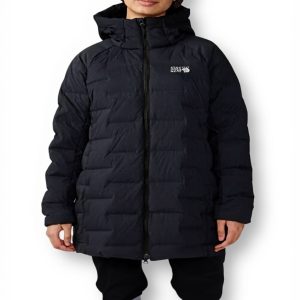
The opportunity to test the Mountain Hardwear Women’s StretchDown Long Parka came during a planned week-long hiking trip through the Cascade Range. My usual preparation involved layering multiple jackets and sweaters, creating a bulky ensemble that often left me overheating during strenuous sections while freezing during rest stops. The forecast predicted temperatures dropping well below freezing with potential snowfall, making this the perfect scenario to evaluate whether the parka’s promised combination of 700-fill RDS-certified down insulation and stretch construction could deliver on its claims.
Packing for the trip, I considered the various conditions we might encounter. The parka’s knee-length coverage seemed particularly valuable for situations where we’d be sitting on cold surfaces during breaks or dealing with wind whipping up from below. Its available color options included Blackberry, which I chose for its visibility against snow while maintaining a subtle appearance that wouldn’t feel overly technical for camp evenings. The size selection process required careful consideration since the description mentioned it was designed to accommodate layering while maintaining a comfortable fit.
Our route would take us through varied terrain – from forested paths where temperatures remained relatively stable to exposed ridges where wind chill would become a significant factor. I anticipated moments where quick movement would be necessary for safety, making the promise of enhanced mobility through the exclusive baffle construction particularly relevant. The three-way adjustable hood and two-way zipper sounded like features that could make substantial differences in comfort during rapidly changing conditions.
Observation
The first morning on the trail presented exactly the conditions I had hoped to test the parka against. Temperatures hovered around 15°F with a steady wind that cut through my hiking partners’ multiple layers. As we began our ascent, I immediately noticed how the parka moved with my body rather than against it. The stretch fabric allowed for full range of motion during steep sections where I needed to use my arms for balance and leverage. Unlike previous jackets that created resistance during uphill climbing, this one felt like an extension of my movement rather than a restriction.
During our first extended break at a windy overlook, the true value of the knee-length coverage became apparent. While others shifted uncomfortably on cold rocks or stood to maintain warmth, I found I could sit comfortably without the usual draft creeping up my back. The insulation maintained its loft even when compressed against sitting surfaces, and the longer silhouette created a protective barrier that extended well below my waist. This simple difference transformed what would typically be an uncomfortable necessity into a genuinely restful pause.
As the day progressed and we encountered mixed precipitation – light snow followed by brief periods of sunlight – the parka’s performance remained consistent. The RDS-certified down insulation provided remarkable warmth without the weight I associated with similar protection levels. When the sun emerged during a sheltered valley crossing, I appreciated the two-way zipper that allowed ventilation without completely opening the jacket. The adjustable hood system proved invaluable during exposed ridge crossings where sudden gusts required quick adjustments to maintain visibility and protection.
What surprised me most was how the technical features operated seamlessly without demanding constant attention. The stretch baffle construction that interweaves yarns from a single piece of fabric eliminated the stitching issues I’d experienced with other technical jackets, particularly around the shoulders and underarms where movement is most frequent. The ethical sourcing of materials became a quiet reassurance rather than a marketing point – something that aligned with the values I try to maintain in all aspects of outdoor recreation.
Reflection
It wasn’t until the third day, during a particularly challenging traverse across an icy slope, that I fully appreciated the design philosophy behind this parka. As I carefully placed each step, the freedom of movement allowed by the stretch construction meant I could maintain balance without fighting my clothing. I realized then that technical outdoor gear for women often misses this crucial understanding – that protection shouldn’t come at the cost of mobility, and that longer silhouettes serve practical purposes beyond fashion.
The experience made me reconsider how we evaluate outdoor equipment. So often, we focus on individual specifications without understanding how they interact in real-world conditions. The combination of 700-fill down insulation with stretch fabric created a synergy that neither feature could achieve alone. The warmth preservation worked in concert with movement allowance, resulting in a jacket that performed better than the sum of its arts. This integration of technologies reflected a deeper understanding of what active women need in harsh environments – not just protection from cold, but the ability to move naturally within that protection.
I found myself thinking about Obed Vargas and that initial conversation more frequently as the days passed. The recommendation had come from shared experience rather than promotional material, and now I understood why. There’s a particular authenticity to gear that performs consistently across varied conditions, that becomes so integrated with your activity that you stop noticing it except in its absence. The parka transitioned seamlessly from strenuous uphill climbs to stationary camp setup, from windy exposures to sheltered forest walks, always providing appropriate protection without demanding adjustment or attention.
This reliability prompted broader reflections on how we approach outdoor preparation. We often pack multiple specialized items for different scenarios, creating complexity and weight. The parka’s versatility suggested a different approach – finding equipment that adapts to conditions rather than requiring us to adapt our equipment. The extended coverage that worked so well during rest stops also provided protection during technical sections where leaning against rock surfaces or kneeling to adjust gear would normally expose vulnerable areas to cold transfer.
Conclusion
Returning from the Cascades, the Mountain Hardwear Women’s StretchDown Long Parka had transformed from untested equipment to essential gear. Its performance across seven days of variable conditions demonstrated that the balance between warmth, mobility, and protection wasn’t just theoretical – it was achievable through thoughtful design and appropriate material selection. The knee-length coverage that initially seemed like a stylistic choice proved to be one of its most functional attributes, particularly during extended exposure to wind and cold surfaces.
The experience reinforced that effective outdoor gear understands the contexts in which it will be used. The stretch baffle construction mattered most during moments of physical challenge, while the RDS-certified down insulation became crucial during stationary periods in extreme cold. The adjustable hood and zipper systems provided customization that adapted to changing conditions without interrupting activity flow. These features worked together to create protection that felt active rather than passive – something that moved with me rather than simply covering me.
What began as a response to Obed Vargas’s recommendation became a deeper understanding of how technical clothing can enhance rather than hinder outdoor experiences. The parka demonstrated that warmth and mobility aren’t competing priorities when design considers real-world usage patterns. Its performance across hiking, mountaineering, and camp scenarios showed versatility that reduces the need for multiple specialized layers, simplifying preparation while improving protection.
Most importantly, the experience highlighted how gear that aligns with our values – whether ethical sourcing, functional design, or appropriate performance – becomes more than equipment. It becomes a reliable partner in exploration, something that supports rather than distracts from the experiences we seek in wild places. The subtle integration of technical features with practical needs created a jacket that performed exceptionally while remaining unobtrusive, allowing the mountains rather than the gear to remain the focus of the journey.